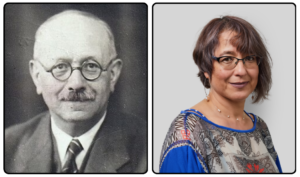
Marc Bloch (left) | Simone Bloch (right)
An Interview with Simone Bloch, Teacher at EFBA since 2010
By Lia Warnke
Published by EFBA — Éducation Française Bay Area
Some stories arrive quietly. A conversation, a name mentioned in passing, a connection you almost didn’t make.
Some stories don’t arrive through textbooks. They arrive through the people already in your life.
Simone Bloch has been part of our EFBA family since June 2010, making her our longest continuously employed teacher. For over 16 years, she has taught French to Bay Area children with a love for the language that runs deeper than words.
She is also the granddaughter of Marc Bloch, one of the greatest historians of the 20th century. On June 23, 2026, he was inducted into the Panthéon in Paris, with his wife Simonne by his side (not to be confused with “our” Simone, whose name has one n). I recently had the privilege of sitting down with Simone to talk about what this historic moment means for her and her family. Not just for France. Not just for the history books. Her family has quietly carried this legacy for generations, across oceans, through war, exile, trauma, and an extraordinary amount of love.
Who Was Marc Bloch?
Marc Bloch was born in 1886 in Lyon, France, into a family from Strasbourg in Alsace—a region on the border between France and Germany that changed national ownership three times across three generations: after the Franco-Prussian War in 1871, Alsace became part of Germany. World War I returned it to France in 1918. Then Nazi Germany reclaimed it in 1939, only for it to be liberated back to France in 1945. This turbulent history shaped Marc Bloch’s life and work as a historian.
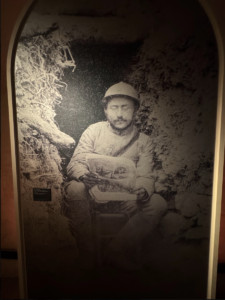
Marc Bloch during WWI.
His father was already a historian before him, and before that, the family line traced back generations of rabbis. Like many Jews who embraced the Esprit des Lumières (‘Enlightenment spirit’), Marc’s father was first and foremost French, a deep believer in the Republic, and a non-practicing Jew. The family carried a deep tradition of intellectual rigor that shaped everything Marc would become. He went on to marry Simonne, with whom he had six children. One of those children would become the father of Simone Bloch, our very own EFBA teacher, and the woman whose voice guides us through this story.
Marc Bloch went on to become one of the most transformative historians of the modern era. Before Bloch, history was studied as a chronological timeline—battles, kings’ reigns, political events strung together in order. What made him revolutionary was his insistence that history could not be understood this way; it could not be studied through a single lens.
“He came to the conclusion that to be serious in history, you need to know about economy, about geography, about sociology, about everything else. You have to combine different human sciences. And that is how he did it.”
Geography, economics, sociology, linguistics He believed the social sciences and the humanities all had to come together. To Bloch, history was a living thing, shaped by forces that no single discipline could explain alone.
He was especially known for his work on the Middle Ages, including his landmark study La Société Féodale. In 1929, together with his colleague Lucien Febvre, he co-founded the journal Les Annales d’Histoire Économique et Sociale, which sparked an entire movement in historical scholarship, introducing a new way of thinking about the past that is still influential today.
Along with Les Annales, his most well-known work, as Simone describes it, is L’Étrange Défaite, or ‘The Strange Defeat’. Written while living through the Nazi occupation and published only after his death, it is a searing account of France’s collapse. What makes this book so valuable is that there is no hindsight, no distance—Bloch applied his deep analytical mind and his historical method to the “current events” of his time, day by day.
“He says that essentially the top wealthy people in France betrayed the rest of the population… they didn’t think it through, because they didn’t understand that the world had changed… and he was living it day to day.”
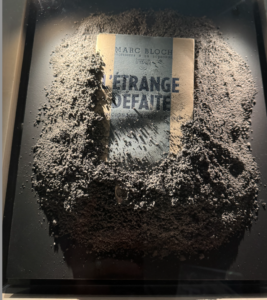
“The Strange Defeat” by Marc Bloch, set as a work of art.
A Man Who Did Not Have to Fight, But Did
A sincere patriot, Marc Bloch was no stranger to war. He served with fierce devotion in World War One (1914 to 1918), rising to the rank of captain. He earned the Croix de Guerre
(equivalent of a Purple Heart for France), a French military honor for bravery in combat, with five citations, as well as the prestigious Légion d’honneur. The war also left marks on his soul that never fully healed.
“My father told me that he must have seen things that were pretty traumatic. He had a hard time even being at a butcher’s shop. My father had very little memories of that time, but the things he did share, I remember.”
By the 1930s, a new danger was rising. It was not only on the battlefield. It was antisemitism. When Hitler came to power in Germany in 1933, the threat to European Jews became unmistakable. In 1938, Germany annexed Austria and then the German-speaking regions of Czechoslovakia, one territory after another. France and England pursued a policy of appeasement, led by Chamberlain and Daladier. They hoped to avoid war, but their weakness only emboldened Hitler and led straight into it. For a Jewish intellectual like Marc Bloch, the writing was on the wall.
When World War Two began in September 1939, Marc Bloch was 53 years old. He was a respected university professor, internationally known, and well past the age of military obligation. He did not have to fight.
He enrolled himself anyway.
As the danger grew, colleagues from around the world invited him to leave France. An invitation to move to the United States came. It was a genuine escape route. But the family situation made it impossible.
“There was a problem. My father and his brother were already over 18 and were not part of the deal. And so he decided to stay in France. The whole family stayed in France.”
Marc Bloch, the historian who understood the sweeping forces of history, made a deeply personal choice. He chose his family over safety.
When France fell in 1940, only part of the country was occupied by the Nazis. The south was governed by a regime that collaborated with them, based in the town of Vichy. It became known as the “Vichy government.” Under its antisemitic laws (Statuts des Juifs), passed between October 1940 and June 1941, Jews were forced to sell their properties and businesses. They were also barred from many professions. Bloch was pushed out of the Sorbonne but received a rare exemption to keep teaching, first in Clermont-Ferrand, then in Montpellier.
In November 1942, Germany occupied the rest of France. In 1943, Bloch went underground and joined “The Army of Shadows”, the Resistance in Lyon, its unofficial capital. He became one of its regional leaders, operating under a false name, moving in secret. His oldest sons, one being Simone’s father, followed in his footsteps, joining the Resistance and fighting in their own right, each in a different part of the country from their father.
Marc Bloch was arrested in Lyon on March 8, 1944 by the Gestapo. He did not speak in spite of being severely tortured by Gestapo chief Klaus Barbie at the Montluc prison. His family knew this with certainty.
“Nobody got arrested after him. That is the sign that he did not say anything.” Simone paused before adding, quietly: “I know he was waterboarded and all kinds of things. I know this is one of the most horrific things that can happen.”
Just 10 days after the Allied forces launched the D-Day invasion at Normandy, Marc Bloch was executed on June 16, 1944, in a field outside Lyon. 28 members of the Resistance were taken from prison that day, brought to a field, and shot. Two people survived; their testimonies became the historical record of what happened. According to those witnesses, Marc Bloch died crying out: Vive la France!
Writing History While Living It
Even while in hiding, Marc Bloch kept writing. He documented what he was witnessing in real time: the collapse of France, the incompetence of its military leadership, the moral failure of its ruling class. The result was L’Étrange Défaite, or The Strange Defeat, a searing analysis of why France fell so quickly to Nazi Germany. He argued that the country’s wealthy elite had essentially handed France over to Hitler, and that the generals had failed catastrophically because they could not grasp that warfare had fundamentally changed — that airplanes and modern strategy had made old tactics obsolete.
He also began writing Apologie pour l’Histoire, ou Métier d’Historien, or The Historian’s Craft in 1940, a meditation on the craft and purpose of history itself. Neither book was published during his lifetime. Both were hidden away and published posthumously. Together, they became two of the most important works in 20th century historiography.
A recent comic book adaptation of his life, Marc Bloch. L’historien combattant, or Marc Bloch, The Fighting Historian, has just been published in France, bringing his story to new and younger audiences.
“I think it is a good way to introduce something in a not too heavy manner. And in French culture, the comic book is really a ninth art. It is not like Marvel. It is like pearls of poetry and creativity.”
The Family’s Conditions for the Panthéon
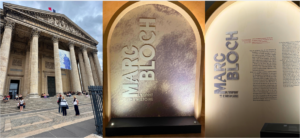
From left: the Panthéon in Paris, the Marc Bloch sign on its facade, and the entrance to his exhibition in the crypt (June 25, 2026-January 10, 2027)
When President Macron proposed inducting Marc Bloch into the Panthéon, the family did not immediately say yes. They gathered across time zones and continents, communicating by email, and deliberated together. Some were enthusiastic. Others were more cautious, echoing a hesitation that had existed in the family for decades. Bloch’s son, Simone’s father, had long worried that his father’s legacy might be politically exploited, “récupéré” as the French say, used in ways the family would not sanction.
In the end, they agreed, but on three conditions.
First: his body would not be moved. He had already been relocated once, from the mass grave where he was executed to the family’s village in central France, where his remains were placed in a small monument alongside others who had been shot. “That is enough,” the family said. “He got moved one time. We do not need to move him a second time.” And so Marc Bloch’s Panthéon induction included only a cenotaph, an empty symbolic coffin. The Panthéon already honors several other distinguished figures this way: Joséphine Baker, Robert Badinter who carried the abolition of death penalty in France in 1981, as well as Germaine Tillion and Geneviève de Gaulle-Anthonioz, notorious members of the French Resistance during WWII.
Second: his wife Simonne would be honored alongside him. It mattered deeply to “our” Simone that her grandmother be known in her own right. Simonne became his closest collaborator, working alongside him every day, raising their six children, and shaping his thinking in ways history rarely credits.
“She was his secretary, meaning she was a collaborator. She was doing everything. Give him advice, everything. And I have read poems that he wrote to her.”
They were, by all accounts, an extraordinary couple.
Third: no far-right political figures at the ceremony.
President Macron accepted all three conditions. The ceremony was scheduled for June 23, 2026. The night before, there was a Veillée républicaine, a kind of public wake, held at the École Normale Supérieure, the higher institution where Marc Bloch was educated. It is a moment of collective silence and homage, not a speech or a prayer, but something closer to a shared meditation.
Marc Bloch is now the 84th person inducted into the Panthéon since it was established during the French Revolution, more than three centuries ago. Only seven of those 84 have been women.
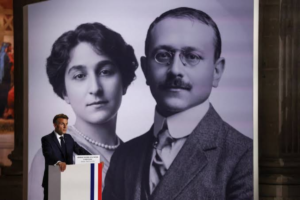
President Emmanuel Macron presides over the Panthéon ceremony honoring Marc and Simonne Bloch.
A Father’s Legacy, a Daughter’s Story
To understand the weight of this moment, you have to understand the man who stood between Marc Bloch and his granddaughter: Simone’s father.
Simone’s father was still fighting in the Resistance when he learned that both his parents had died. That moment shaped the rest of his life.
“He made a promise when he found out that his mother and his father had died while he was a soldier and was himself in the Resistance. He made a promise to do everything he could for the legacy of his father.”
He spent his life as a judge, but also as an activist against torture and unjust imprisonment. He went to Ireland, to Brazil, to Italy…. His daughter said it took her years to understand why.
“As a little girl, I knew my father was like that. I didn’t connect it. And then later, I understood. The root of his passion was his own father. What had been done to him.”
He was deeply, fiercely against the military, even though he had served in it. He was against nationalism, though deeply patriotic. He unionized. He pushed back against authority when he believed it was wrong. He passed down to his children an ethic of intellectual honesty that was not negotiable.
“Intellectual honesty is a big deal in my family. Always going back to the source. Verifying things. Not taking things for granted.”
He also passed down, perhaps without meaning to, an enormous weight.
“On one hand, there is pride, and somehow an obligation, a responsibility, and on the other hand, there is this shadow where you just crumble.”
She spoke of her father with deep admiration and a kind of tenderness that comes from having fully seen someone. She mentioned a car crash in the United States when she was thirteen. Her father was still conscious when help arrived. The first thing he said was: “My papers are there.” Thinking of his family, even in that moment, before he passed out.
“I do not know if I am super courageous, I just know that I have intervened in situations where it was risky. People fighting, and I am like, ‘no. I cannot let that happen’.”
Simone’s father died before the Panthéon ceremony was officially confirmed, but he knew his own father would enter it.
“That was already something,” Simone said.
A Legacy Still Being Written
The story does not end with Marc Bloch, or with his son.
One of his granddaughter’s nephews, Matis Bloch, the son of Simone’s late brother, has become a historian. He is now carrying the scholarly legacy forward, giving lectures and conferences, keeping the work alive. “I am really happy that it keeps going,” Simone said.
The University of Strasbourg, the city her father’s family came from, was named Université Marc Bloch for twenty years. It had been blocked earlier by antisemitism. When the proposal came back decades later, it won. Today, streets, schools, and plazas across France carry his name.
And yet, for his granddaughter, Simone, sitting in the Bay Area and teaching French to children, the legacy can feel both enormous and distant at the same time. She speaks with a deep sense of humility about her place within it.
“I always felt very small, because I cannot do anything but just live my life. And I always wonder: What would I have done? What would I do?
What Marc Bloch’s Story Means for Our Students
At EFBA, we believe the French language carries more than vocabulary and grammar. It carries history, memory, and values. Marc Bloch understood that better than almost anyone. He believed that to understand the present, you must go back to the sources, ask questions, sit with complexity, and refuse easy answers.
In many ways, Marc Bloch’s own life embodied that same approach she hopes her students can hold onto: a commitment to asking hard questions, returning to sources, and refusing to look away from complexity. He fought for France not out of obligation, but out of conviction, guided by a belief that truth and understanding mattered even in the most difficult circumstances. He did not survive the war, but the way he thought, and the principles he lived by, endured.
Marc Bloch’s legacy continues, and so does the story of those who carry it forward.
When asked what she would want EFBA’s students to take from her grandfather’s life and teachings, Simone did not hesitate.
“Integrity. Courage. And intellectual honesty. Go back to the source. Verify. Do not just take things for granted. And asking questions constantly.”
Written By Lia Warnke
[/fusion_text][/fusion_builder_column][/fusion_builder_row][/fusion_builder_container]
