How Children Learn to Read in French at EFBA
And Why This Question Is Never Neutral
By Bianca Monaco, COO at EFBA
Every parent comes to the question of reading with a personal history.
Some of us learned to read with the méthode syllabique: B + A = BA.
We sounded things out, slowly, methodically, letter by letter.
Others grew up with the méthode globale, learning to recognize words visually—almost photographically: this word is “la,” this one is “maman.” In France, these approaches are still deeply emotional and controversial. They worked well for some children, and much less well for others.
So when families join EFBA, the question they are really asking is not abstract or theoretical. It is concrete—and often a little anxious:
“Are you really going to teach my child to read in French?”
And just as importantly:
“Are you going to teach them the right way?”
You Only Learn to Read Once in Your Life
This sentence matters, so we’ll say it again: You only learn to read once in your life.
Learning to read means learning how written symbols represent sounds, how those sounds blend into words, and how those words carry meaning.
After that, you read to learn—for the rest of your life.
Learning to read is not about memorizing words. It is not about guessing from pictures or context. And it is not a neutral process: the way reading is taught can either support all children—or unintentionally leave some behind.
I too come to this work with my own reading history. My first language is Portuguese, and I learned to read using a phonics-based approach (método fônico). French is not my strongest language, and I’m not a native speaker—but I’ve seen, both personally and professionally, how powerful explicit sound-based instruction is, especially for multilingual learners.
That perspective shapes how I think about reading at EFBA: with respect for research, for language structure, and for the realities of families who don’t all come with the same linguistic background.
What Research Shows Today
At EFBA, we base our didactics on the latest research findings. Today, decades of research (often referred to as the science of reading) identify several essential components of effective reading instruction, including phonemic awareness, phonics¹, fluency, vocabulary, and comprehension.
In practice, these components come together through a developmental process:
- children learn to distinguish the sounds of a language
- they learn to decode the written symbols that represent those sounds
- they use this foundation to access meaning, vocabulary, and comprehension
If children are not yet able to clearly distinguish the sounds of a language, decoding is not accessible to them—yet.
That is why sound awareness is a central part of how we teach reading at EFBA.
At EFBA, we also root our teaching in a growth mindset philosophy. The ability to hear and distinguish sounds is not fixed—it can be taught, especially at a young age. These are developmental skills that can be strengthened through intentional instruction. And instruction makes the difference.
Historically, approaches that relied heavily on guessing tended to work best for children who already had a very rich linguistic environment at home. They were far less effective for bilingual learners or children who did not grow up surrounded by intentional conversation and a wide variety of books in the language they are learning.
Where EFBA Stands Today
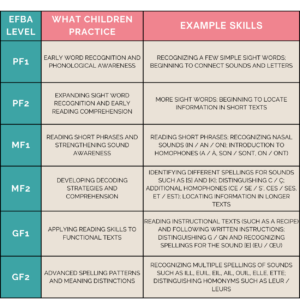
At EFBA, our approach to reading in French is explicit, structured, and evidence-based, while remaining deeply attentive to each child.
We begin with phonological awareness: helping children truly hear and manipulate the sounds of French. French has its own sound system, and children must first internalize those sounds orally before they can read them on a page.
From there, we teach children to decode: to connect sounds to written symbols, to blend them, and to read words accurately. This step is essential. It is what allows reading to become reliable rather than approximate.
As decoding becomes more automatic, children can focus increasingly on meaning—vocabulary, comprehension, and the pleasure of reading.
This approach is closer to what many families recognize as the méthode syllabique, but informed by decades of research and adapted to the realities of today’s bilingual and multilingual learners.
This is one of the most common concerns we hear, and it deserves a clear answer.
EFBA does not interfere with your child’s main school or English reading instruction.
French reading follows the structure of the French language.
English reading follows the structure of English.
Children are fully capable of learning both, and they do not confuse them. A five-year-old learning to read in French and English is not “learning twice.” They are building one strong reading foundation, supported by two sound systems.
Learning to read in French at EFBA does not slow down or compromise reading development in English. Or vice versa.
What This Looks Like for Children
Between roughly ages 5 and 9, children are learning how to read; after that, they read to learn.
At EFBA, this means:
- Explicit attention to sounds, phonics, and decoding
- Rich oral language in the classroom
- Vocabulary developed through stories, projects, and conversation
- A gradual move toward fluent, meaningful reading
For children who arrive already reading in English—or another language—we adapt carefully, without rushing or forcing artificial parallels.
What Parents Need to Do at Home
Parents play an essential role: not as reading instructors, but as reading role models.
A few simple practices make a real difference:
- Read aloud in French when possible
- Let your child see that you enjoy reading. Children don’t just imitate books—they imitate readers.
- Reading volume matters, but it should not feel like pressure. Pleasure comes first.
- Talk about words: “What do you think this word means?”
- With younger children, explain words naturally in context
- With older children, teach them how to use a dictionary, explore related words, and follow their curiosity. Talk about etymology and the connections between languages—many words are transparent across French and English, while others are “faux amis” that look similar but mean something different. Noticing these patterns strengthens vocabulary and deepens understanding.
- As children grow older and reading becomes more fluent, encourage reading for pleasure. Time spent reading independently—stories they choose and enjoy—plays a key role in building fluency, vocabulary, and confidence.
Having books in French at home matters, not for performance, but for familiarity, confidence, and pleasure.
EFBA is in its 17th year as I write this article. Out Founder and Executive Director, Gabrielle Durana has long dreamed to create a « French médiathèque » where we could welcome all interested families to read, play games and borrow children books to take home. The power of visualization has been our passion and secret sauce. Maybe one day this project will become reality thanks to the support of the community. In the meantime you may borrow more modest amounts of French children’s books from your child’s classroom.
What If You Don’t Speak French?
Many EFBA families are not fluent in French—and that is not a barrier to supporting your child’s reading development.
You do not need to teach your child to read in French at home. That is our role.
What matters most is not perfect pronunciation or grammar, but the relationship your child builds with language, books, and learning.
Here are meaningful ways non-French-speaking families can support their child:
- Read together in any language.
The habit of reading, listening to stories, and talking about books transfers across languages. - Show curiosity about French, even if you are learning too.
Saying “I don’t know this word—let’s look it up in the dictionary / let’s ask your teacher” models learning, not limitation. - Talk about meaning.
Ask questions like “What is this story about?” or “What happened next?” Discussions can happen in English or another home language. - Create space for French without pressure.
Listening to French songs, stories, or audiobooks helps normalize the language. - Let EFBA handle the technical side.
Decoding, phonics, and structure are taught at school. Your role is to support confidence, curiosity, and consistency.
Children do not need fluent parents to become fluent readers. They need adults who value language, books, and who are readers themselves..
What This Means for Your Child
Learning to read is one of the most consequential things a child will ever do. It deserves clarity, intention, and expertise.
At EFBA, reading in French is not treated as an add-on or an experiment. When families ask, “Are you really going to teach my child to read in French?” The answer is yes. We do so carefully, explicitly, and with deep respect for how children learn—especially children growing up with more than one language.
Progress will not look identical for every child, and it is not meant to. What matters is that each child builds a strong, transferable foundation that will support them for years to come—in French, in English, and beyond.
Key Takeaways
|
¹ Phonemic awareness refers to the ability to hear and manipulate the individual sounds in spoken words. Phonics refers to connecting those sounds to written letters or letter combinations.
[/fusion_text][/fusion_builder_column][/fusion_builder_row][/fusion_builder_container]
